Showing posts with label Bill of Rights. Show all posts

Tuesday, July 7, 2020

Lincoln and Slavery

It sounds ridiculous and unnecessary, researching Lincoln and slavery. But I'm vetting American heroes with an emphasis on racism, and finding surprises and a slow evolution in Lincoln's words and actions.

Lincoln served in the Illinois Assembly and U.S. House of Representatives as a member of the Whig Party from 1834 to 1849, He opposed both slavery and abolition, saying in 1837: 

"[The] Institution of slavery is founded on both injustice and bad policy, but the promulgation of abolition doctrines tends rather to increase than abate its evils."

What he did support at that time was the program of the American Colonization Society to settle freed slaves in Liberia.1

He re-entered politics in 1854 as a leader in the new Republican Party, created after thKansas–Nebraska Act allowed slavery to expand West.2 In 1854 he said:

"If A. can prove, however conclusively, that he may, of right, enslave B.---why may not B. snatch the same argument, and prove equally, that he may enslave A?---

You say A. is white, and B. is black. It is color, then; the lighter, having the right to enslave the darker? Take care. By this rule, you are to be slave to the first man you meet, with a fairer skin than your own.

You do not mean color exactly?---You mean the whites are intellectually the superiors of the blacks, and, therefore have the right to enslave them? Take care again. By this rule, you are to be slave to the first man you meet, with an intellect superior to your own.

But, say you, it is a question of interest; and, if you can make it your interest, you have the right to enslave another. Very well. And if he can make it his interest, he has the right to enslave you."3 (emphasis added)

In the first Lincoln Douglas debate in 1858:
“I have no purpose to introduce political and social equality between the white and the Black races. There is a physical difference between the two, which in my judgment will probably forever forbid their living together upon the footing of perfect equality, and inasmuch as it becomes a necessity that there must be a difference, I, as well as Judge Douglas, am in favor of the race to which I belong, having the superior position.”(emphasis added)
But at the same time he noted privately:
"As I would not be a slave, so I would not be a master. This expresses my idea of democracy. Whatever differs from this, to the extent of the difference, is no democracy."5
The conclusion is that Lincoln personally opposed slavery, but was willing to publicly tolerate it in the South. His primary goal was to preserve the Union, and he was willing to continue slavery for that. In an 1862 letter to the editor of the New-York Tribune, Horace Greeley, he wrote:
"If I could save the Union without freeing any slave I would do it, and if I could save it by freeing all the slaves I would do it; and if I could save it by freeing some and leaving others alone I would also do that. . . I have here stated my purpose according to my view of official duty; and I intend no modification of my oft-expressed personal wish that all men every where could be free."6

Lincoln eventually issued the Emancipation Proclamation, freeing slaves in the Confederacy. He pushed the 13th Amendment abolishing slavery in all the United States, and recommended extending the vote to African Americans.7 

But as Frederick Douglass said at the dedication of The Freedmen’s Monument in Lincoln Park, Washington, DC in 1876:

" . . . even here in the presence of the monument we have erected to his memory, Abraham Lincoln was not, in the fullest sense of the word, either our man or our model. In his interests, in his associations, in his habits of thought, and in his prejudices, he was a white man. He was preeminently the white man’s President, entirely devoted to the welfare of white men. He was ready and willing at any time during the first years of his administration to deny, postpone, and sacrifice the rights of humanity in the colored people to promote the welfare of the white people of this country."8 (emphasis added)
Racist, or merely pragmatist? Perhaps Douglass recognized Lincoln's slow change with his qualification of "first years". Or maybe at the end Lincoln felt his first task was safely accomplished.


1 Republican Party (United States)Wikipedia, retrieved 7/6/20. 
2 Abraham LincolnWikipedia, retrieved 7/6/20. 
3 Fragment on SlaveryCollected Works of Abraham Lincoln, ed. Roy P. Basler et al, The Abraham Lincoln Association, Volume 2, pp. 222-223, April 1, 1854?, retrieved 7/7/20.
4 First Debate with Stephen A. Douglas at Ottawa, IllinoisCollected Works, Volume 3, pg. 16, August 21, 1858, retrieved 7/7/20. 
5 Definition of DemocracyCollected Works, Volume 2, August 1, 1858?, retrieved 7/7/20. 
6 Letter to Horace GreeleyCollected Works, Volume 5, pg. 388, August 22, 1862, retrieved 7/6/20. 
7 Lincoln on Slavery, National Park Service, retrieved 7/6/20. 
8 Oration in Memory of Abraham Lincoln, Frederick Douglass, April 14, 1876.

Friday, June 26, 2020

The Chicks: "March March" and "Shut Up & Sing"


March March, by Natalie Maines, Emily Strayer, Martie Maguire, Jack Antonoff, Dan Wilson, Ian Kirkpatrick, Ross Golan

“If your voice held no power, they wouldn’t try to silence you.” - unknown 
Use your VOICE. Use your VOTE.


Shut Up And Sing (2006), by Barbara Kopple and Cecilia Peck

A political music video featuring Rick Rubin, George W. Bush, and the Lipton Tea Lady.

Friday, June 1, 2018

The NFL and Patriotism as a Marketing Tool

New Orleans Saints quarterback Drew Brees (9) kneels down with teammates before the U.S. national anthem was played ahead of an NFL football game against Miami Dolphins at Wembley Stadium in London, Sunday Oct. 1, 2017. Saints players then stood when the anthem was played. (AP Photo/Tim Ireland)

The NFL owners have decided to fight a recent loss of television viewers with a dose of patriotism (NFL Policy Will Require Players on Field to Stand for Anthem, Show Flag 'Proper Respect', Scooby Axson, Sports Illustrated, May 23, 2018). The issue worsened last year when Donald Trump said that owners should fire players who disrespected the flag. One problem is that it's not clear whether the viewer loss is due to player demonstrations or changes in the broadcast market and viewing technology.

Another problem is that the player's union has not agreed to the new rules. The owners are allowing the players to remain in the locker rooms during the anthem, but the NFL Players Association has said:

Saturday, May 12, 2018

Second Class Citizens

After the recent passage of WISCONSIN ACT 248, "involving a boycott of Israel," and a City of Madison Mayoral Proclamation (below) declaring an "Israel Day," I thought we might benefit from some facts on the legal status of non-Jewish citizens of Israel.

Americans are too willing to assume that the only democracy in the Middle East has a written Constitution and Bill of Rights like theirs. The examples below are legal discrimination by the Israeli government. This unequal treatment under the law applies to over 1.7 million Israeli citizens in Israel, more than 21% of the population.1 By comparison, African Americans are 13% of the U.S. population.12

A 2005 letter to the University of Wisconsin-Madison Badger Herald argued that Israel was not South Africa:
    The divestment campaign in South Africa was appropriate and legitimate because it garnered international recognition of apartheid, an internal system of exploitation and segregation forced upon a black majority by a white minority. Divestment legitimately targeted corporations that profited from this egregious situation. While some have argued that Israel is conducting apartheid policies against the Palestinian people and Arab-Israeli citizens, this comparison is absurd. Arab-Israeli citizens retain the same civil and political rights that any Jew possesses in Israel, with the ability to vote in elections and serve their constituents as elected officials. (emphasis added)

Unfortunately, this is not true. Israeli laws, and the civil and political rights they define, are different for different Israeli citizens. Israel's purpose in this is to maintain its status as a Jewish state, as Roland Nikles commented:

Monday, December 25, 2017

Corporate Personhood

Corporate personhood is the legal notion that a corporation, separate from its associated owners, managers, or employees, has legal rights and responsibilities enjoyed by natural persons. This is an ongoing legal debate in the United States.

A chronology of U.S. court decisions that define corporate personhood (with an explanation of citations):
     
  • Trustees of Dartmouth College v. Woodward – 17 U.S. 518 (1819) Beginning with this opinion the Supreme Court has continuously recognized corporations as having the same rights as natural persons to contract and to enforce contracts. "The opinion of the Court, after mature deliberation, is that this corporate charter is a contract, the obligation of which cannot be impaired without violating the Constitution of the United States. This opinion appears to us to be equally supported by reason, and by the former decisions of this Court."
  •  
  • Society for Propagation of Gospel v. Town of Pawlet - 29 U.S. 480 (1830), in which an English corporation dedicated to missionary work sought to protect its rights to land in the U.S. under colonial grants against an effort by the state of Vermont to revoke the grants. Justice Joseph Story, writing for the Supreme Court, explicitly extended the same protections to corporate-owned property as it would have to property owned by natural persons. Seven years later, Chief Justice Marshall stated: "The great object of an incorporation is to bestow the character and properties of individuality on a collective and changing body of men."
  •  
  • Santa Clara County v. Southern Pacific – 118 U.S. 394 (1886). Chief Justice Waite of the Supreme Court orally directed the lawyers that the Fourteenth Amendment equal protection clause guarantees constitutional protections to corporations in addition to natural persons, and the oral argument should focus on other issues in the case. "The court does not wish to hear argument on the question whether the provision in the Fourteenth Amendment to the Constitution, which forbids a State to deny to any person within its jurisdiction the equal protection of the laws, applies to these corporations. We are all of the opinion that it does."

Sunday, March 27, 2005

Jefferson on a Living Constitution

I am not an advocate for frequent changes in laws and Constitutions, but laws must and institutions must go hand in hand with the progress of the human mind. As that becomes more developed, more enlightened, as new discoveries are made, new truths discovered and manners and opinions change, with the change of circumstances, institutions must advance also to keep pace with the times. We might as well require a man to wear still the coat which fitted him when a boy as civilized society to remain ever under the regiment of their barbarous ancestors.
Thomas Jefferson, as inscribed on the Jefferson Memorial

Though I have many reservations about Thomas Jefferson, I much prefer his 18th-century view of constitutional interpretation to that with which Justice Scalia would like to saddle us in the 21st.
Roger Wilkins, professor of history at George Mason University

Thursday, June 19, 2003

Political Science

Climate change has global consequences for human health and the environment.
Example of changes to an Environmental Protection Agency report made by White House officials under George W. Bush, June 19, 2003

Political staff are becoming increasingly bold in forcing agency officials to endorse junk science.
Jeremy Symons, a climate policy expert at the National Wildlife Federation, June 19, 2003

Evolution is back in Kansas.
Headline after the Kansas Board of Education reversed its 1999 vote, February 21, 2001. Two other fundamental scientific theories, cosmology (the origin and fate of the universe), and plate tectonics (the movement of continents), were also restored to the classroom.


In 1999 Darwinists launched a vicious campaign of threats and ridicule when the Kansas State Board of Education refused to require that Darwinism be taught as the sole explanation for life's diversity. (They did not ban the teaching of evolution, as the media widely misreported.) Sadly, those tactics paid off the following year, when state elections shifted the board's membership enough to reimpose the old orthodoxy.
Mark Hartwig, Focus on the Family magazine, 2002. The theories of evolution and intelligent design are treated as matters of religious orthodoxy and opinion.


On the issue of evolution, the verdict is still out on how God created the Earth.
George W. Bush, 2002

Can Science Conquer Kansas?
Headline after the Kansas Board of Education voted 6-4 on August 11 to make evolution a local option in the state's 304 school districts, September 27, 1999

Kansas just embarrassed itself on the national stage.
Dr. John Staver, chairman of a 27-member committee of scientists and teachers that had worked for more than a year on questions of science and religion in the Kansas public schools, August 11, 1999

Tuesday, March 11, 2003

Freedom of Speech

Exceptions to majority rule


In 1912, feminist Margaret Sanger was arrested for giving a lecture on birth control. Trade union meetings were banned. Peaceful protesters opposing U. S. entry into World War I were jailed. In 1923, author Upton Sinclair was arrested for trying to read the text of the First Amendment at a union rally. It was in response to the excesses of this period that the ACLU was founded in 1920.
Freedom of Expression, ACLU Position Paper

Stephen Downs, 61, of Selkirk, New York was arrested Monday on a trespassing charge after wearing a T-shirt saying "Peace on Earth" and "Give Peace a Chance" in Crossgates Mall.
Associated Press, March 11, 2003
Wal-Marts are private property. This means that Wal-Mart has the right to ask you to leave their premises if they do not approve of your behavior. The situation is trickier on sidewalks and parking lots owned by Wal-Mart. Though these spaces are technically private, some courts will still protect your free speech rights there because traditionally they are "public" forums. The Supreme Court explicitly left this issue up to the states in Pruneyard Shopping Center v. Robins, after which states have differed in their conclusions, most falling on the side of protecting property.

The state decisions have focused on large shopping malls that have taken over the traditional functions of a downtown's Main Street. The states of Alaska, California, Colorado, Massachusetts, New Jersey, and Oregon have all made rulings that favor protecting free speech on these types of private property. Arizona, Connecticut, Georgia, Michigan, New York, Ohio, Pennsylvania, South Carolina, Washington, and Wisconsin courts have all ruled against protecting speech in these situations. Most states are still undecided on this issue, but lean towards the majority view that speech is not protected on private property.
― National Labor Committee In Support Of Worker And Human Rights, March 9, 2003
"You mean, it's the content of my sign?" I asked him. He said, "Yes, sir, it's the content of your sign."
Brett Bursey, before his arrest by airport police in Columbia, SC, October, 2002.
Bursey was told he was trespassing, but was later charged by United States Attorney J. Strom Thurmond, Jr. for being in an area restricted by the Secret Service to protect President Bush. Bush supporters in the area were not arrested.

Friday, February 28, 2003

Patriotic Ceremonies

Exceptions to majority rule


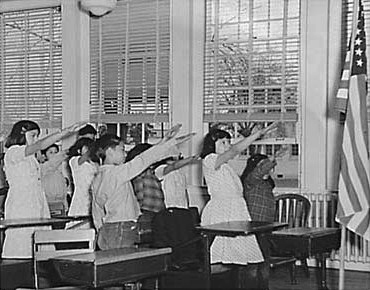
Students pledging to the flag with the Bellamy salute, March
1941

No official, high or petty, can prescribe what shall be orthodox in politics, nationalism, religion, or other matters of opinion. . . To believe that patriotism will not flourish if patriotic ceremonies are voluntary and spontaneous instead of a compulsory routine is to make an unflattering estimate of the appeal of our institutions to free minds.
U.S. Supreme Court Justice Robert Jackson, in West Virginia State Board of Education v. Barnette, 1943, striking down a requirement that school children salute the flag.

One of the things that the flag stands for, the Court said that day, was the right not to salute it.
— Ira Glasser, 1991. The Supreme Court decision was made in the middle of World War II.


Iwo Jima Flag Raising, Joe Rosenthal, 2/23/45, ©1945 Associated Press
World Trade Center Flag Raising, Thomas E. Franklin, 9/11/01, ©2001 The Record (Bergen County, NJ)

Two patriotic moments. Voluntary, spontaneous, not routine.

Monday, January 13, 2003

Faith-Based Government

Out of fear, ignorance and occasional bigotry, faith-based groups have been prohibited from competing for federal funding on a level playing field with secular groups.
Attorney General John Ashcroft, White House Faith-Based and Community Initiatives Conference, January 13, 2003. President Bush issued an executive order last month prohibiting federal agencies from discriminating against religious organizations in awarding grants for social work, but religious groups that become federal contractors may still discriminate in hiring on the basis of religious beliefs.

In 1996, then-U.S. Senator John Ashcroft steered through Congress so-called “charitable choice” provisions intended to allow religious groups to garner federal funding without proper civil rights and civil liberties safeguards. Ashcroft, an ally of the Religious Right, wanted faith-based providers to be able to hire and fire based on religion, even in programs supported by taxpayer dollars.
The 'Faith-Based' Initiative, Americans United for Separation of Church and State, 2017

Saturday, January 1, 2000

Scientific Methods

I often say that when you can measure what you are speaking about, and express it in numbers, you know something about it; but when you cannot measure it, when you cannot express it in numbers, your knowledge is of a meagre and unsatisfactory kind; it may be the beginning of knowledge, but you have scarcely in your thoughts advanced to the state of Science, whatever the matter may be."
Sir William Thomson, Lord Kelvin, 1883

A theory in science is not a hunch or 'just a theory' as some say. It is an explanation built on multitudinous confirmed facts and the absence of incompatible facts. Omitting evolution from biology is comparable to leaving the U.S. Constitution out of civics lessons.
Maxine Singer, molecular biologist and president of the Carnegie Institution of Washington, August 16, 1999
Scientific Method
First, information is gathered by careful observation of the phenomenon being studied. On the basis of that information a preliminary generalization, or hypothesis, is formed, and this in turn leads to a number of implications that may be tested by further observations and experiments. If the conclusions drawn from the original hypothesis successfully meet all these tests, the hypothesis becomes accepted as a scientific theory or law; if additional facts are in disagreement with the hypothesis, it may be modified or discarded in favor of a new hypothesis, which is then subjected to further tests. Even an accepted theory may eventually be overthrown if enough contradictory evidence is found, as in the case of Newtonian mechanics, which was shown after more than two centuries of acceptance to be an approximation valid only for speeds much less than that of light (emphasis added).
— The Columbia Encyclopedia, 2000